
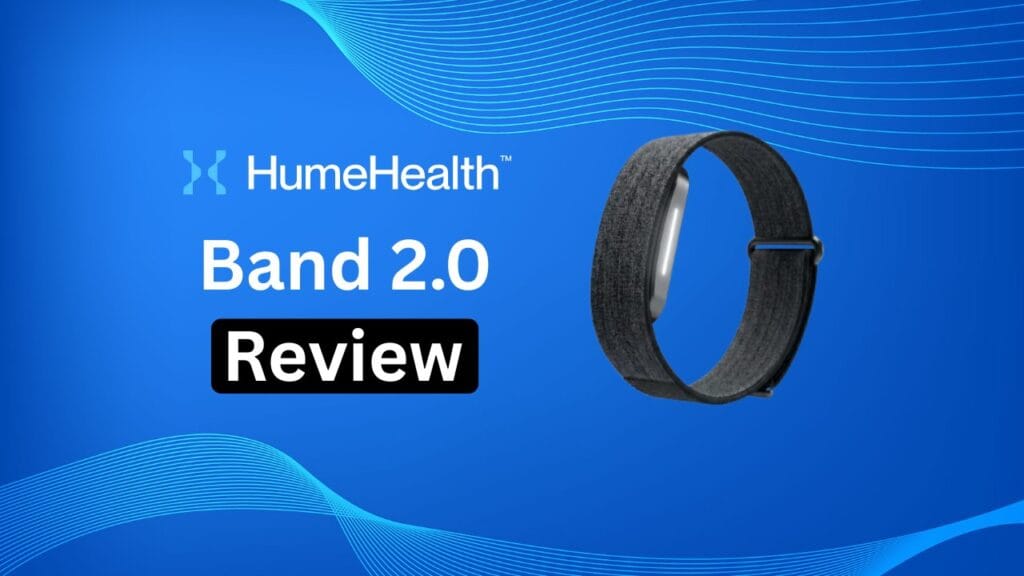
⚡ Quick Answer
The Hume Band is a $249 fabric-strap health tracker (US price) that monitors heart rate, HRV, blood oxygen, sleep stages, skin temperature, and activity. The 2.0 model runs up to 14 days per charge, is IP68 water-resistant, and needs no subscription, so you own it outright. Code SYNC20 takes 20% off on top of the sale price, tested at checkout. Score: 8.3/10.
Why most buyers say yes to the Hume Band 2.0
- ✓ No mandatory subscription: pay once and keep your data
- ✓ Up to 14 days of battery, about 30 minutes to charge
- ✓ 45-day refund policy and free worldwide shipping
- ✓ Code SYNC20 takes 20% off at checkout
Official Hume store · 45-day refund policy · Free worldwide shipping · Halloween sale on now
Most trackers make you a deal: buy the band, then keep paying to see what your own body is doing. The Hume Band skips the second half. You pay once, wear it for up to two weeks and keep your data. Here is what that looks like in real life, and whether it is the right band for you.
What is the Hume Band? The Hume Band is a wrist-worn health tracker with a soft fabric strap that measures sleep, heart rate, recovery, and daily activity, then sends the data to a companion app.
Most fitness bands do the basics: steps, heart rate, maybe sleep. The Hume Band aims higher, layering on recovery scores, skin temperature, and a set of longevity-focused metrics, while promising up to two weeks of battery and no subscription lock-in. This review covers what it tracks, how the two versions differ, how it stacks up against the Oura Ring, and how to read the bolder health claims on Hume’s site.
How the Hume Band works
The band uses an optical sensor array of 5 LEDs and 4 photodiodes pressed against your wrist. Those sensors shine light into the skin and measure how it reflects back, which lets the device estimate heart rate, heart rate variability (HRV), blood oxygen (SpO2), and respiration. Movement sensors track activity and sleep patterns on top of that.
The strap is a soft, breathable fabric rather than the rigid plastic or metal of most trackers, and it’s thin enough that Hume markets it as comfortable enough to wear 24/7, including through the night for sleep tracking. It carries an IP68 rating, so it handles sweat, handwashing, and splashes without trouble.
Data syncs to the Hume app on iOS and Android, and the app connects with Apple Health and Google Fit if you want your numbers alongside data from other apps.
What the Hume Band tracks
The core metrics are the ones you’d expect from a serious health tracker:
- Continuous heart rate and heart rate variability (HRV)
- Blood oxygen (SpO2) and respiratory rate
- Sleep stages (light, deep, REM) and sleep quality
- Skin temperature
- Activity, strain, and recovery scores
On top of those, Hume adds a set of proprietary, longevity-focused metrics it calls things like Metabolic Momentum, Metabolic Capacity, and Biological Age. These are Hume’s own calculated scores, meant to give you a single trend line for how your habits are trending over time rather than a clinically defined measurement. Treat them as motivational trend indicators, not medical readings.
Hume Band Battery Life: The Standout Feature
Battery is where the Hume Band separates itself from the pack. The 2.0 model is rated for up to 14 days on a single charge, and the 1.0 model lasts around 4 to 5 days. A full charge takes roughly 20 to 80 minutes depending on how empty it is, and Hume states that five minutes on the dock buys about a day of tracking, which is the number that actually matters when you notice a dead band right before bed.
That matters more than it sounds. A tracker only helps if you actually wear it, and the fastest way to lose sleep data is a device that dies overnight because you forgot to charge it. Two weeks between charges means the band mostly stays on your wrist and off the charger.
Charges in about 30 minutes · 45-day refund policy
Biological Age and Pace of Aging: the longevity metrics
This is the part of the Hume Band that people search for as the “real age” metric, and it is the clearest difference between this band and a standard fitness tracker. Alongside the usual heart rate and sleep data, Hume reports a Biological Age estimate and a Pace of Aging reading: an attempt to express whether your daily habits are aging you faster or slower than the calendar.
How to read those numbers honestly: they are modelled estimates derived from the metrics the band collects, not a laboratory measurement of your cells. A blood-based epigenetic test measures biological age one way; a wrist sensor infers a directional signal from heart rate, HRV, sleep, and activity patterns. The useful question is not “is this number my true age” but “is this number moving in the right direction over months, under habits I actually changed.”
Used that way, it earns its place. Watching Pace of Aging drift down after a quarter of better sleep is a more motivating feedback loop than another step count, and it is the reason people pick this band over a cheaper tracker. Treat it as a trend line, not a diagnosis.
Hume Band pricing
The Hume Band 2.0 is $249 during the current sale, down from a $356 list price. That figure is the US price: Hume prices regionally, so if you are ordering from outside the United States, check the official store for your country’s number rather than assuming this one converts directly. A payment plan (18 payments of about $13.84) is available, and the device is HSA/FSA eligible in the US.
Discount code SYNC20, tested at checkout
We didn’t just copy a coupon and hope it works. We ran SYNC20 through the official checkout again in October 2026, and it still stacks on top of the store’s own sale rather than replacing it. The order started at $249.06, SYNC20 took off a further $49.81, and that left $199.25 before shipping and tax. On our test order, estimated taxes were $14.45, for a total of $213.70 and total savings of $156.55 against the list price.
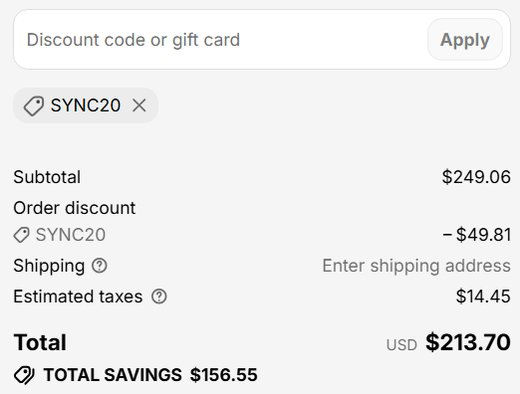
Two caveats worth stating plainly. Hume nudges its sale price by a few dollars from day to day, so your cents may differ, though the 20% has applied on top of every sale price we have checked. And the totals above are the US store: Hume prices regionally, so shoppers in other countries will see a different base price and a different final number, even with the same code.
💸 How to apply it: open the official store, add the Hume Band 2.0 to your cart, then type SYNC20 into the “Discount code” field at checkout and hit Apply. The 20% comes off the already-discounted price, before shipping and tax.
| Item | Price | What you get |
|---|---|---|
| Hume Band (hardware) | $249 (sale, from $356) | Device + free app tier + 1-year warranty |
| Extended warranty | $35-$50 | 10-year coverage, optional |
| Hume Plus (app) | from $8.99/month | AI coaching, deeper analysis, optional |
The key thing: the subscription is optional. The free app tier gives you the core metrics, and you keep the hardware forever. That’s a real difference from some competitors where the monthly fee is mandatory to see your own data.
Sleep in One Strap, Sweat in the Other
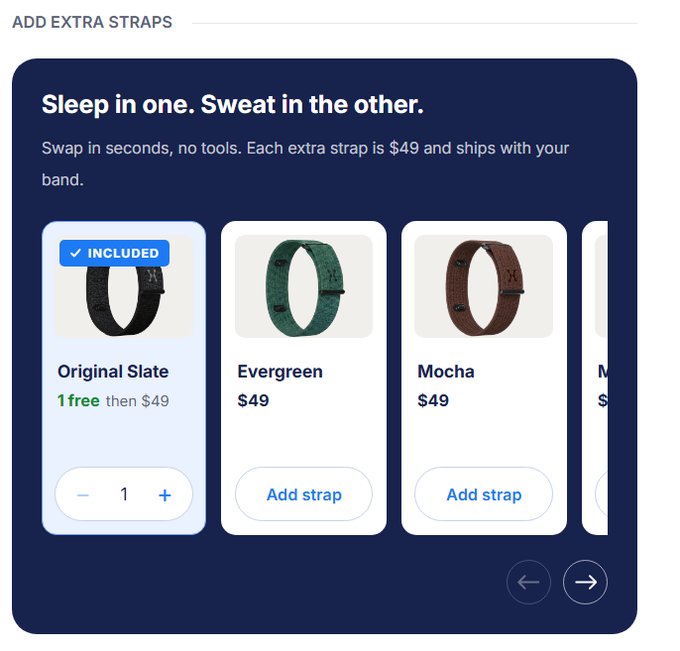
Every Band 2.0 ships with its own Original Slate strap, and the official store now sells extra straps in more colors. Swapping takes seconds and needs no tools, so you can keep one strap for sleep and a fresh one for workouts or for the days you want a different look.
- Original Slate is included with your band
- Extra straps are $49 each and ship with your band, in colors such as Evergreen, Mocha, Midnight Blue and Glacier
- More colors are on pre-order, including Blush, Red Wine, Sandstone and Electric Lime
- You can also order two or three bands at once if you want to share one with a partner or the household
Official store · 45-day refund policy · Free worldwide shipping
Try It Risk-Free: Refund Policy, Warranty and Shipping
The easiest way to know whether the Hume Band fits your life is to wear it. The official store makes that low-risk:
- 45-day refund policy: try it at home for 45 days and send it back if it is not for you (Hume asks for the band in like-new condition and its original packaging)
- 1-year warranty included, with an optional extended warranty at checkout
- Free worldwide shipping
- No subscription required to see your own data
- HSA/FSA eligible in the US
Buying from the official store is what activates the refund policy and the warranty.
Code SYNC20 takes 20% off at checkout
Hume Band vs Oura Ring
The Oura Ring is the obvious comparison, so here’s the honest breakdown. If you are weighing the Hume Band against a training-focused strap instead, our Hume Band vs Whoop comparison covers that matchup, including the two-year cost of each.
| Hume Band | Oura Ring | |
|---|---|---|
| Form factor | Fabric wrist strap | Finger ring |
| Battery life | Up to 14 days (2.0) | About 7 days |
| Subscription | Optional ($8.99/mo) | Required for full features |
| Price | $249 one-time (sale) | $299+ plus membership |
| Data export | Yes | Limited |
The trade-off is form factor and refinement. Oura has years of accuracy tuning and a polished app, and some people simply prefer a ring to a wrist strap. But if you don’t want a mandatory monthly fee and you value going two weeks between charges, the Hume Band makes a strong case. If body composition is what you’re after instead of daily wear metrics, the brand’s smart scale is covered in our Hume Body Pod review.
Hume Band Pros and Cons: The Good and the Bad
What is good and bad about the Hume Band? The good: up to 14 days of battery, no required subscription, a comfortable strap you can actually sleep in, and longevity metrics most trackers do not attempt. The bad: those longevity scores are proprietary estimates rather than clinical measurements, the brand has less independent accuracy testing than Oura, a wrist strap will not suit people who want a ring, and the AI coaching sits behind an optional monthly plan.
✅ Pros
- Up to 14 days of battery on the 2.0, far longer than most trackers
- No mandatory subscription, you own the device and see core data free
- Comfortable fabric strap designed for 24/7 and overnight wear
- Tracks the metrics that matter: HRV, SpO2, sleep stages, recovery
- HSA/FSA eligible with a payment plan option
❌ Cons
- Longevity metrics (Biological Age, etc.) are proprietary scores, not clinical measurements
- Newer brand than Oura, with less independent accuracy testing to point to
- Wrist strap won’t suit people who prefer a ring form factor
- Deeper AI coaching sits behind the optional monthly plan
What Hume says about the health features
Hume markets the band with some ambitious claims, including cuffless blood pressure trends, early detection signals for chronic conditions, and an average life-expectancy gain among engaged users. It’s worth being clear about what those are: marketing figures and wellness estimates from the company, not clinical trial results or medical diagnoses.
The Hume Band is a consumer wellness tracker. It’s genuinely useful for spotting trends in your sleep, recovery, and activity over time, and those trends can be motivating. But it is not a medical device, it doesn’t diagnose or treat anything, and it shouldn’t replace real medical screening or a conversation with your doctor. Read the longevity and detection features as helpful nudges, not as a substitute for professional care.
Who is the Hume Band for?
It’s a strong fit if you want detailed sleep and recovery data, hate charging a device every couple of days, and don’t want to pay a monthly fee just to see your own numbers. People building better sleep and exercise habits, and anyone who wants a comfortable band they can genuinely wear around the clock, will get real use out of it.
It’s less of a fit if you specifically want a ring, or if you need the most clinically validated accuracy on the market and are willing to pay a subscription for it. In that case the Oura Ring may suit you better.
Official Hume store · 45-day refund policy · Free worldwide shipping
Is the Hume Band worth it?
At around $249 (US) with up to two weeks of battery and no required subscription, the Hume Band is one of the more practical health trackers available right now. The long battery life and the fact that you own your data outright are the strongest arguments in its favor, and the comfortable fabric strap makes 24/7 wear easy.
Go in treating the longevity metrics as motivational trends rather than medical readings, and it’s an easy tracker to recommend for anyone who wants rich sleep and recovery data without the ongoing cost that comes with some of its rivals.
More Gadgets for Your Daily Routine
A tracker works best next to simple habits. If water is one of yours, read our AquaFusion hydrogen bottle review, a rechargeable glass bottle built to make drinking water a habit. For the scale that pairs well with a tracker, see our Hume Body Pod review.
FAQ
Does the Hume Band track steps?
Yes. Along with heart rate, HRV and sleep, the Hume Band 2.0 tracks steps, distance, active zone minutes and calories around the clock. Its focus is recovery, sleep and long-term health trends rather than sport-specific training.
How long does it take to charge the Hume Band 2.0?
A full charge takes about 30 minutes, and a full charge lasts up to 14 days.
Does the Hume app work with Google Fit and Apple Health?
Yes. The Hume app is available on iOS and Android and connects with Apple Health and Google Fit, so you can see your numbers next to data from other apps.
Is there a refund policy for the Hume Band?
Yes. Hume offers a 45-day refund policy and a 1-year warranty, with free worldwide shipping from its official store. Buying from the official store is what activates them.
Can I swim or shower with the Hume Band 2.0?
Yes, within the IP68 rating: water-resistant to about 1 meter for up to 2 hours, which covers showers and pool laps. Avoid hot tubs and saunas. Our guide to whether the Hume Band is waterproof covers every situation.
Does the Hume Band have a screen or notifications?
No. There is no screen, GPS or notification buzz. Everything lives in the phone app, which keeps the band light and simple to wear all day and all night.
Is the Hume Band legit?
Hume Health sells the band directly through its official store with a 45-day refund policy. Metrics such as biological age are the company’s own estimates rather than clinical measurements, so treat them as trends over time.
What are the pros and cons of the Hume Band?
The main advantages: up to 14 days of battery on the 2.0, no mandatory subscription so you own the device and your data, a fabric strap comfortable enough for 24/7 and overnight wear, and longevity metrics like Biological Age that most trackers do not offer. The main drawbacks: those longevity scores are proprietary estimates rather than clinical measurements, Hume is a newer brand with less independent accuracy testing than Oura, the wrist form factor will not suit people who prefer a ring, and the AI coaching layer costs $8.99 per month on top.
Is the Hume Band worth it?
For people who want long-term health trends without a recurring bill, yes. At around $249 in the US you own the hardware outright, the core tracking never expires, and two weeks of battery means it actually stays on your wrist. It is worth less to serious athletes, who get more actionable output from a training-focused device, and to anyone who wants clinically validated numbers rather than wellness estimates.
How long does the Hume Band battery last?
The Hume Band 2.0 lasts up to 14 days on a charge, and the version 1.0 lasts around 4 to 5 days. Both charge fully in roughly 30 minutes, which is a standout compared to most fitness trackers that need charging every day or two.
Does the Hume Band require a subscription?
No. The free app tier covers the core metrics, and you own the device outright. An optional premium plan from $8.99/month adds AI coaching and deeper analysis, but it isn’t required to use the band. Our guide to what the Hume Band subscription does and does not include breaks down free versus premium feature by feature.
Is the Hume Band a medical device?
No. It’s a consumer wellness and fitness tracker, not a diagnostic medical device. It isn’t intended to diagnose, treat, or prevent any condition, and it shouldn’t replace medical screening or advice from a doctor.
How does the Hume Band compare to the Oura Ring?
The main differences are battery life and cost structure. The Hume Band advertises up to 14 days of battery with no mandatory subscription, while the Oura Ring lasts about a week and requires a monthly membership to unlock its full features. The Oura Ring is a ring form factor; the Hume Band is a wrist-worn strap.
Is the Hume Band waterproof?
It carries an IP68 rating: dust-resistant and water-resistant to about 1 meter for up to 2 hours, and Hume lists showers and swimming as fine. Worth separating two different questions, though: surviving water is not the same as tracking a swim workout. For the full breakdown of showers, pools, sea water, and saunas, see our guide to whether the Hume Band is waterproof.
Ready to track your sleep and recovery?
Official store · Free worldwide shipping
Check Today’s Price · 45-Day Refund Policy →
Related reviews
How this review was made: we read the official page and checkout ourselves, verify prices, dates and recurring charges at the source, and never repeat a figure taken from another review site. Read our full review methodology and affiliate disclosure.