⚡ Quick Answer
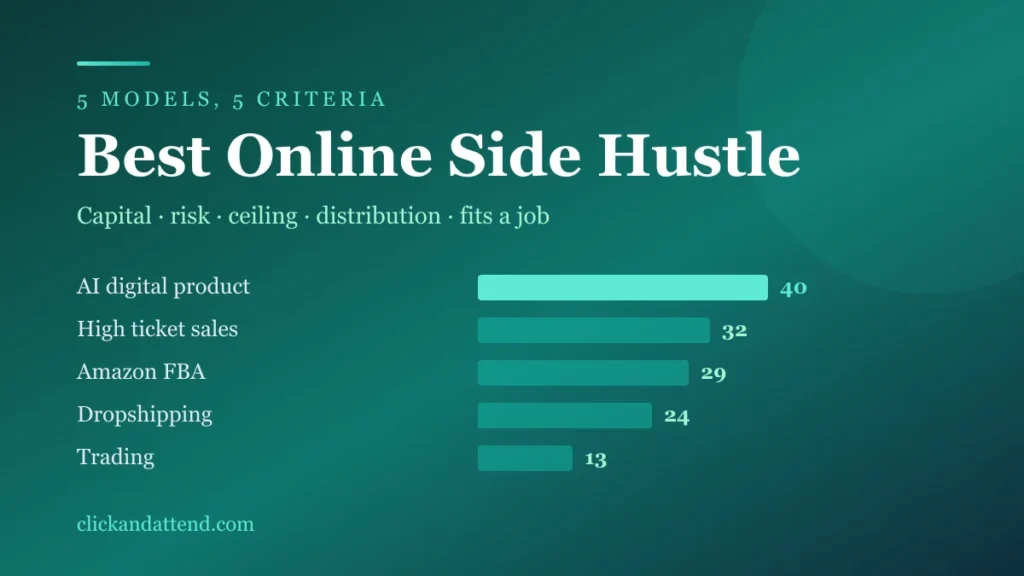
For someone with a job and no spare capital, the best online side hustle is selling a digital product built with AI. Scored on starting capital, downside risk, income ceiling, distribution effort and whether it fits around a job, it wins four of the five. It loses one, and we say which. Trading finishes last, and it is not close.
You have a job. You have maybe an hour on weeknights. You do not have a few thousand dollars sitting idle to gamble on a business idea.
That is not a limitation to apologise for. It is a filter, and it eliminates most of what gets recommended to you.
So here are the five models people actually mean by best online side hustle, scored on the four things that decide whether you can start at all.
The Four Criteria (and Why Everything Else Is Noise)
- Starting capital and time to first sale. How much money leaves your account before any comes in, and how long you wait.
- Risk of losing money. Not “is it hard”. Can you end a month poorer than you started?
- Income ceiling. If it works, how far does it go?
- Distribution effort. How hard is it to get in front of someone who will pay? This is the one nobody scores, and it is the one that kills most attempts.
- Does it fit around a job? You have one. Any model that needs you available between nine and five is competing with your employer, and your employer is currently winning.
Scores are out of 10, higher is better, for a maximum of 50. A high score on criterion 4 means distribution is easy, and a high score on criterion 5 means you can do it after work.
The Comparison at a Glance
| Model | Capital & speed | Risk | Ceiling | Distribution | Fits a job | Total |
|---|---|---|---|---|---|---|
| AI digital product | 9 | 9 | 8 | 5 | 9 | 40 |
| High ticket sales | 8 | 8 | 7 | 6 | 3 | 32 |
| Amazon FBA | 3 | 4 | 8 | 8 | 6 | 29 |
| Dropshipping | 4 | 4 | 6 | 4 | 6 | 24 |
| Trading | 4 | 1 | 7 | n/a | 1 | 13 of 40 |
Trading has no distribution problem, because the market is your counterparty rather than a customer you must find. It is scored on the four criteria that apply, out of 40, and still finishes last by a distance.
On the first four criteria, first and second are separated by a single point. The whole gap opens on the fifth, and the fifth is the one that describes you: you already have a job. High ticket sales is an excellent business that mostly happens while you are at work.
5. Trading: The Only One Where You Can Finish Poorer
Trading gets sold as a side hustle because it looks like it fits: no product, no customers, work from a laptop.
The evidence is unusually clear, and it is not from bloggers. Analysing every trade on the Taiwan Stock Exchange over fifteen years, Barber, Lee, Liu, Odean and Zhang found that 97 percent of day traders lose money net of trading fees (“Learning, Fast or Slow”, Review of Asset Pricing Studies).
A separate study of the Brazilian futures market by Chague, De-Losso and Giovannetti followed around 20,000 people who started day trading. Among the 1,500 most persistent, 17 individuals earned more than the Brazilian minimum wage net of fees. Seventeen. And the authors found no evidence that traders improved with experience.
Earlier work by Barber and Odean on 66,465 US accounts found active traders underperformed the market by about 10.3 percent a year (“Trading Is Hazardous to Your Wealth”, Journal of Finance).
Score: 13 of 40. Every other model on this list can fail by earning you nothing. This is the only one that can fail by taking what you already have. It also requires you at a screen during market hours, which is the one thing a person with a job does not have.
Trading in one line
It is not a side hustle. It is speculation with a business costume on.
4. Dropshipping: The Model That Quietly Stopped Being Free
The pitch has not changed in a decade: no inventory, no warehouse, the supplier ships for you.
All true, and all beside the point. The product was never the hard part. Paid traffic is the actual business, and ad money leaves your account before any sale arrives. You are buying attention at auction against people with larger budgets and more data.
Margins are thin, so a campaign that “almost” works still loses money. Refunds, chargebacks and slow shipping complaints all land on you, not the supplier.
Score: 24/50. Viable if you have a few thousand to test with and you genuinely enjoy media buying. It is a poor first move on a tight budget, and it is marketed almost exclusively to people on tight budgets.
3. Amazon FBA: Real Business, Wrong Order
FBA deserves more respect than it gets in beginner comparisons, because it solves the hardest problem on this list: Amazon hands you buyers. Nobody has to discover your brand. They are already searching.
That is why it scores 8 on distribution, higher than the model that wins overall.
The problem is the order of operations. You buy inventory first. You pay fees, storage and returns. Units that do not sell become a bill rather than a lesson. All of that risk sits in front of your first customer instead of behind them.
Score: 29/50. A genuinely good business, and the wrong first step for someone whose constraint is capital. Come back to FBA when losing a few thousand dollars would annoy you rather than hurt you.
2. High Ticket Sales: The Runner-Up, and It Is Close
Here is where most comparisons cheat, by making the second option look weak. This one is not weak.
You close high-value offers for someone else’s company and take a commission. Starting capital is essentially zero. And critically, the company supplies the leads, which means distribution, the thing that sinks everyone else, is handled for you.
If you are naturally good on the phone, this may genuinely beat the winner for you. Say so out loud rather than letting a table decide.
The trade-offs are real, though. You do not own anything here: the offer, the leads and the brand belong to someone else, and the arrangement can end without you having any say in it. The income also stops the moment you do, because no call means no commission, which makes this a second job with better economics rather than an asset you are building. And the calls happen during business hours, which is exactly when your employer expects to see you at your desk.
Score: 32/50. It scores second on four criteria out of five and last but one on the fifth, because the calls happen while you are employed. If your job ends, or it is flexible enough to take calls, move this straight to the top of your list. For anyone locked to a desk between nine and five, that single row decides it.
1. AI Digital Product: The Best Fit for This Specific Situation
You build something once, using AI to do the production work, and sell it repeatedly. A template pack for an industry you know. A course. A tool. A system.
Why it wins on capital
Free tiers of the main AI assistants cover a real amount of the work. Your first sale can arrive before your first subscription, which reverses the order that sinks FBA and dropshipping. If the product flops, you lost time, not rent money.
Why it wins on risk
There is no inventory to write off, no ad spend to burn, no position that can move against you overnight. The worst realistic outcome is that nobody buys.
Why it fits someone with a job
This is the quiet advantage. Trading needs you during market hours. High ticket sales needs you on calls during business hours. A digital product is the only model here that keeps working during your shift. You also never have to appear on camera, which for a lot of people is the difference between starting and not starting.
And there is real evidence the tool favours beginners
In a study of 5,179 workers, Erik Brynjolfsson, Danielle Li and Lindsey Raymond measured a 14 percent average productivity gain from a generative AI assistant, rising to 34 percent among the least experienced and close to nothing for the most experienced (NBER Working Paper 31161).
AI closes gaps rather than widening leads. If you have been losing to people who could afford skills you could not, this is the first tool in a long while that narrows the distance.
And demand is not saturated where it counts: US Census Bureau data shows firms with fewer than 20 employees still under 20 percent AI use, while Federal Reserve analysis puts overall adoption around 18 percent. Most small businesses near you have not started.
The Honest Weakness: It Loses on Distribution
Scoring 5 out of 10, this is the weakest column for the winner, and we are not burying it, because it is the reason most people who try this fail.
It scores 5 rather than lower for one reason worth naming: this distribution problem is solved with effort, not with money. Dropshipping has the same weak score and you can only fix it by buying ads. Here you fix it by finding one person who already has the audience. For someone starting with no capital, a problem you can work your way out of is genuinely a different problem from one you can only pay your way out of.
AI removed the production bottleneck. It did nothing about the distribution one. Anyone can make the product now, which is exactly why making it is no longer worth much. Nobody automatically sees yours.
The people who succeed solve that in one specific way: they attach to an audience that already exists instead of spending a year building one. Partnering with someone who already has the attention, and supplying the product behind the scenes, turns the weakest score on the page into the strongest position.
That is the whole game, and it is where a comparison article stops being useful and watching someone do it starts.
Free to attend · Starts September 6 · Replays for registrants
Where to See This Model Applied
Russell Brunson and Iman Gadzhi run a free five-session Side Hustle Summit built around this exact model: using AI to create the product, and partnering with people who already have audiences so you do not have to build one or show your face. The final session builds one from scratch, live.
It costs nothing to attend and replays are included. The organizers do advertise a specific daily income figure in their marketing, and you should treat that the way this article treats every such number: as a best case from the people selling the training, not a typical result.
A test you can apply to any income claim
The US Federal Trade Commission has proposed requiring sellers of money-making opportunities to hold written substantiation for earnings claims and to hand it over to any consumer who asks. You do not need to wait for a rule to use the idea. Ask for the substantiation. The answer tells you most of what you need.
If you want the wider view before deciding, our guide to AI side hustles covers which patterns hold up and which are already crowded, and is the Side Hustle Summit legit handles the trust question on its own.
The Short Answer
If you have capital to risk, Amazon FBA is a real business. If you are good on the phone and want money soon, high ticket sales is excellent. Dropshipping still works too, provided you enjoy media buying and have a budget to test with.
If you have a job, little capital, and an hour on weeknights, build a digital product with AI and attach it to somebody else’s audience. It is the only model here that keeps earning while you are at work, and that is what the fifth criterion is measuring.
And whatever you choose, do not choose trading.
Free · 5 live sessions · Starts September 6 · Replays included
Starting from zero rather than choosing between models? We wrote the practical version in how to start an online business with no money, including the 30-day sequence and the purchase that costs beginners the most.
Rather not be on camera at all? We filtered the same territory for privacy and for people with a day job in faceless side hustles that work around a job.
Frequently Asked Questions
What is the best online side hustle for beginners with no money?
Selling a digital product built with AI, or high ticket sales. Both need close to zero starting capital. Trading, Amazon FBA and dropshipping all require money before you can earn anything, which rules them out if your constraint is capital rather than time.
Is trading a good side hustle?
No, and this is the clearest answer in the whole comparison. Peer-reviewed studies across two countries found that the large majority of day traders lose money net of fees, and that persistence does not fix it. As a side hustle it fails on risk, and it is the only option here where you can end a month owing money.
Is dropshipping still worth it?
It works, but it is no longer a no-money model. The product is easy; the paid traffic is the business, and ad budget is spent before any sale is made. If you have a few thousand to test with and you enjoy media buying, it is viable. As a first side hustle on a tight budget it is a hard start.
How much money do you need to start Amazon FBA?
Enough to buy inventory up front, plus fees, plus the units that do not sell. That capital is at risk before a single customer sees your listing. FBA’s real advantage is that Amazon supplies the buyers, which is the hardest part of every other model, so it is a strong option once you have capital to lose.
What is high ticket sales and is it a real side hustle?
You close high-value offers for someone else’s company and take a commission. It genuinely needs no capital and the company supplies the leads, which solves distribution. The trade-offs: you do not own anything, income stops when you stop, and you have to be on live calls and good at selling.
Why is an AI digital product the best option for most beginners?
It scores best on the two constraints most beginners actually have: near-zero starting capital and near-zero downside if it fails. You own the asset, it keeps selling while you work your job, and you do not need to appear on camera. Its real weakness is distribution, which is a solvable problem rather than a money problem.
What is the catch with AI digital products?
Distribution. AI made producing the product almost free, which means everyone can produce one, and nobody automatically sees yours. The models that work attach to an audience that already exists instead of trying to build one from scratch.
Can I start an online side hustle while working full time?
Yes, and it should be the filter you judge every option by. Trading requires you at the screen during market hours. High ticket sales requires you on calls during business hours. A digital product is the only one on this list that keeps working during your shift.
Sources & References
- Brad M. Barber, Yi-Tsung Lee, Yu-Jane Liu, Terrance Odean and Ke Zhang, “Learning, Fast or Slow”, Review of Asset Pricing Studies. Taiwan Stock Exchange, 1992 to 2006: 97 percent of day traders lose money net of trading fees.
- Fernando Chague, Rodrigo De-Losso and Bruno Giovannetti, “Day Trading for a Living?” (2020). Brazilian futures market: of the 1,500 most persistent day traders, 17 earned more than the Brazilian minimum wage net of fees, with no evidence of learning over time.
- Brad M. Barber and Terrance Odean, “Trading Is Hazardous to Your Wealth”, Journal of Finance, vol. 55, no. 2. 66,465 US accounts: active traders underperformed by about 10.3 percent annually.
- Erik Brynjolfsson, Danielle Li and Lindsey Raymond, Generative AI at Work, NBER Working Paper 31161, published in The Quarterly Journal of Economics, vol. 140, no. 2 (2025), pp. 889 to 942.
- U.S. Federal Trade Commission, FTC Proposes Rule Changes and New Rule to Deter Deceptive Earnings Claims.
- U.S. Census Bureau, Large Firms With at Least 20 Employees Biggest AI Users, Business Trends and Outlook Survey (published May 26, 2026).
- Board of Governors of the Federal Reserve System, Jeffrey S. Allen, Monitoring AI Adoption in the U.S. Economy (published April 3, 2026).
The three trading studies are cited without links because their publishers block direct access. Titles, authors and journals are given in full so you can look them up yourself.
Related reviews
How we checked this: every figure here is read at the primary source and linked, never taken from another article. Where a number is someone’s own claim about their product, we say so in the text. Read our full review methodology and affiliate disclosure.