⚡ Quick Answer
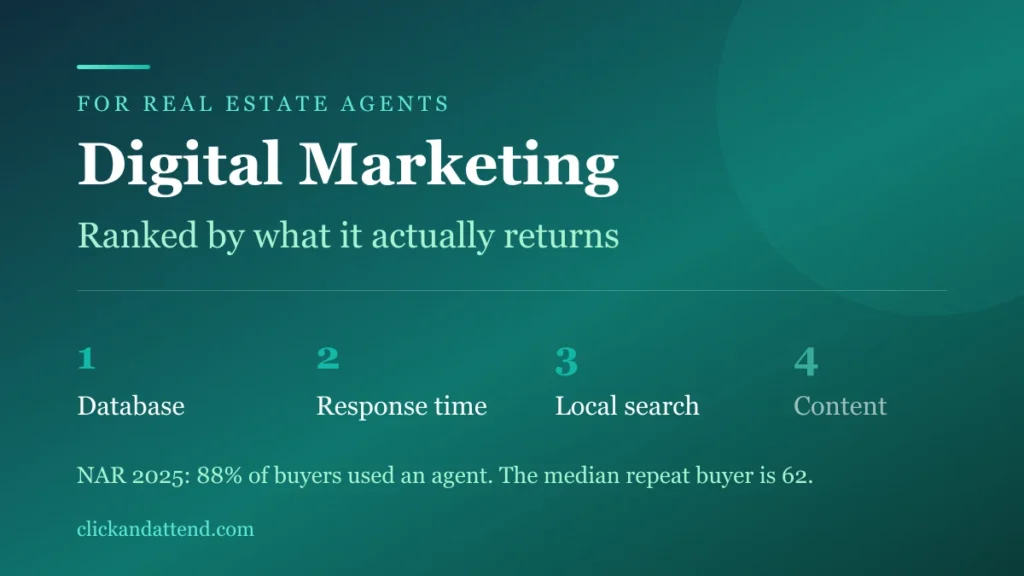
Digital marketing for real estate agents pays in a specific order: your existing database first, your response time second, local search third, and content last. That order surprises people because the advice you usually hear runs backwards. The 2025 NAR data explains why: 88% of buyers and 91% of sellers used an agent, and the median repeat buyer is now 62 years old. You are marketing to people who already own homes and already know agents, which is a relationship problem before it is an audience problem.
What is digital marketing for real estate agents?
Digital marketing for real estate agents is the set of online activities that keep you findable and responsive to people who are actively buying or selling. In practice that means four things: your database and how you follow up with it, your presence in local search, the content attached to your listings, and how fast you answer an enquiry.
It is worth separating from what the phrase usually implies. Most advice aimed at agents is really about building an audience. That is one route, it is the slowest one, and it is not where an agent with a full diary should start.
You have watched an agent in your market build a following and wondered whether you are falling behind by not posting.
Here is the more useful question. Of the deals that closed in your office last quarter, how many came from a stranger who saw a video, and how many came from someone who already knew the agent or found them at the exact moment they were searching?
Below: what the 2025 numbers say about who is actually buying, the four channels ranked by what they return to a working agent, and a 30-day sequence that costs nothing to run.
Who You Are Actually Marketing To
The generic playbook assumes a young first-time buyer scrolling at night. The 2025 NAR Profile of Home Buyers and Sellers describes a different market.
| What the data says | 2025 figure |
|---|---|
| Buyers who used an agent or broker | 88% |
| Sellers who used an agent or broker | 91% |
| First-time buyer share | 21%, the lowest since records began in 1981 |
| Median age, first-time buyer | 40, the highest ever recorded |
| Median age, repeat buyer | 62 (it was 36 in 1981) |
| All-cash buyers | 26%, an all-time high |
| Years sellers owned before selling | 11 (median) |
Read those together and the strategy writes itself. The people transacting are in their forties, fifties and sixties. They already own property. A quarter of them are paying cash. And nine out of ten of them work with an agent.
They are not hard to reach. They are hard to be remembered by. That is a different problem, and it needs different marketing.
It also explains the eleven-year number. Someone who bought through you in 2015 is, statistically, approaching the moment they sell. Your database is not a dead list. It is a queue.
The Four Channels, Ranked by What They Return
1. Your existing database
Highest return, lowest cost, least glamorous. Every past client, every enquiry that went cold, every open house signature. These people have already met you, which is the expensive part of marketing and you have already paid for it.
The work is unromantic: one list, the date you last spoke to each person, and a schedule you can actually keep. Monthly beats quarterly, and quarterly beats the birthday card you send once and forget.
2. Response time
Portal enquiries do not go to you. They go to several agents at once, and the appointment usually belongs to whoever replies first.
This is the one place where a tool pays for itself immediately, because the enquiry that arrives at 7:40pm while you are at a showing is the one you lose by answering it the next morning. An automatic first reply buys you the hour you need to send a real one.
3. Local search
A complete Google Business Profile with real photos and recent reviews is the cheapest credibility you can buy, and it costs nothing. When someone gets your name from a friend, this is the page they check before calling.
Most agents claim the profile and never finish it. Finishing it is an afternoon of work that keeps paying.
4. Content and social
Last, and last on purpose. Content compounds, which is another way of saying it pays late. It is the right investment when you have the first three working and want the pipeline to grow without you.
It is the wrong first move for an agent who is losing enquiries to slow replies, because it adds work to the top of a funnel that leaks at the bottom.
14-day free trial · $97/month after · Unlimited contacts
The 30-Day Start, at Zero Cost
None of this needs software in the first month. Software helps once the habit exists, and it is the reason most agents buy a CRM and abandon it: the tool arrives before the routine does.
| Week | The one thing |
|---|---|
| 1 | Complete your Google Business Profile. Real photos, correct hours, three review requests sent. |
| 2 | Build one list of every past client and cold enquiry, with the date you last spoke. |
| 3 | Fix response time. Automatic first reply, then a human one within the hour. |
| 4 | Run one reactivation campaign to the whole list. A specific local market update, not a greeting. |
Four weeks, four tasks, nothing bought. If week four produces conversations and you cannot keep up with them by hand, that is the signal to look at software. Not before.
When Software Starts Earning Its Keep
The honest trigger is volume. When you are managing follow-up across more people than you can hold in your head, a platform stops being an expense and starts being the reason deals do not fall through the gaps.
What agents typically want by that point is one place for the database, automatic replies to portal enquiries, and a calendar people can book into without a phone call. All-in-one platforms bundle those, which is why they are common in this industry, and entry pricing tends to sit around $97 a month with unlimited contacts.
We looked at the most widely used one for agents specifically in our GoHighLevel for real estate agents review, including the setup work it genuinely requires and the cases where it is the wrong purchase.
Three Mistakes That Cost Agents the Most
- Building an audience before fixing the leak. Posting daily while portal enquiries sit unanswered until morning is paying to fill a bucket with a hole in it.
- Buying the CRM first. The tool does not create the habit. Run the list in a spreadsheet for a month, then buy something to hold what already works.
- Marketing to the wrong age. If the median repeat buyer is 62 and your entire strategy is short-form video aimed at 28-year-olds, you are producing content for people who are not transacting yet.
If You Want the Structured Version
Everything above you can run alone. Some agents want a curriculum, a coach and a room of people doing the same thing, which is a legitimate shortcut and a real expense.
We reviewed the two best known options for agents at opposite ends of the price range: Market Leader LIVE, a three-day in-person event, and Marketing Mastery, a twelve-month coaching program. The full ladder of what is available sits in our guide to Krista Mashore programs.
Neither is necessary to do the four things on this page. Both exist because doing them consistently, alone, is harder than reading about them.
Where to Start This Week
Pick the database. It is the least exciting item on the list and the only one where the people already know your name.
An hour with a spreadsheet and eleven years of past clients will tell you more about your next closing than a month of posting will. Then fix the reply speed, because the enquiries you already receive are worth more than the ones you have not earned yet.
14-day free trial · No card tricks · Cancel inside the trial
Frequently Asked Questions
What is digital marketing for real estate agents?
Digital marketing for real estate agents is the set of online activities that keep you findable and responsive to people who are buying or selling: your database and follow-up, your presence in local search, your listing content, and the speed at which you reply to an enquiry. For most agents it is a retention and response system before it is an audience-building system.
How much does it cost to start?
You can start at zero. A Google Business Profile, a spreadsheet of past clients and a disciplined follow-up habit cost nothing but time. Paid tools become worth it once the volume of leads outgrows what you can answer by hand, and an all-in-one platform typically runs around $97 a month at the entry level.
Do real estate agents really need social media?
You need to be findable and credible, and social media is one route to that rather than the only one. It pays off slowly and it competes with your working hours. If you have limited time, fixing your response speed and working your existing database will return more this quarter than starting a content channel will.
What is the fastest digital marketing win for a new agent?
Response time. Portal enquiries go to several agents at once, so replying within minutes rather than the next morning changes who gets the appointment. Set up an automatic first reply, then follow it with a personal one.
How many past clients should I be contacting?
All of them, on a schedule you can keep. NAR reports that sellers had owned their home for a median of 11 years before selling, so your database is a long cycle rather than a dead list. Someone who bought through you eight years ago is closer to selling than any stranger you could advertise to.
Should I pay for leads or generate my own?
Paid leads buy speed and cost margin; owned channels take longer and keep the margin. Most agents end up with both. Start with the owned side because it does not stop working when you stop paying, and add paid leads when you have a follow-up system that will not waste them.
Does AI change real estate marketing?
It lowers the cost of producing content and handling routine follow-up, which means production is no longer the bottleneck. Attention and trust still are. Use it to answer faster and to stay consistent, not to publish more of what nobody reads.
How long before digital marketing produces a closing?
Weeks for response and database work, months for search and content. The first has an immediate effect on deals already in motion. The second compounds, which is why agents who start it in a slow market are the ones with pipeline in a busy one.
Sources & References
- National Association of REALTORS, Top 10 Takeaways from NAR’s 2025 Profile of Home Buyers and Sellers. Source for the 88% and 91% agent-use figures, the 21% first-time buyer share, the median ages of 40 and 62, the 26% all-cash share and the 11-year median tenure.
- National Association of REALTORS, Highlights From the Profile of Home Buyers and Sellers. The annual report series the figures above are drawn from.
Related reviews
How we checked this: every figure here is read at the primary source and linked, never taken from another article. Where a number is someone’s own claim about their product, we say so in the text. Read our full review methodology and affiliate disclosure.